

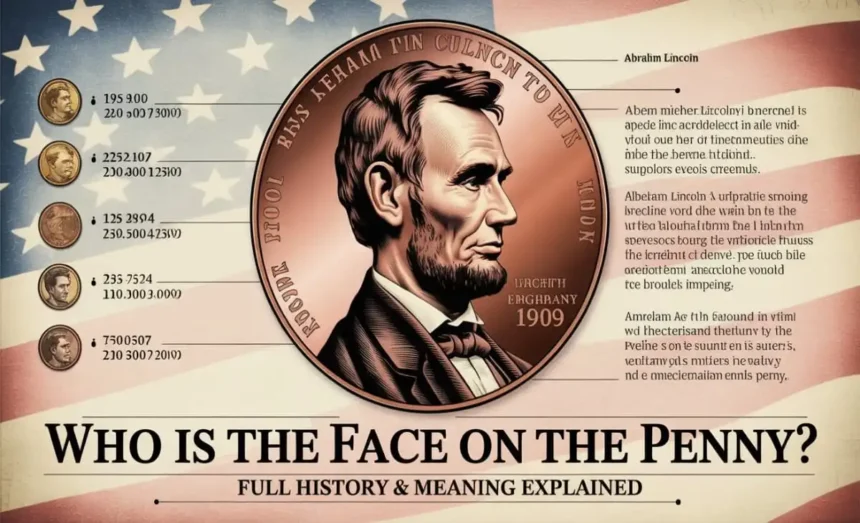
The penny is often overlooked, dismissed as spare change, or left forgotten in drawers and jars. Yet despite its low monetary value, it holds immense historical and cultural importance. One of the most frequently asked questions about this humble coin is who is the face on the penny, and why has that face remained unchanged for more than a century?
For many Americans, the penny is their first introduction to national history. It is often the first coin a child recognizes, the first piece of money placed into a piggy bank, and the first object that silently introduces a historical figure into everyday life. The answer to this question is not just a name, but a story deeply connected to American identity, struggle, and ideals.
Understanding who is the face on the penny requires exploring the man himself, the historical moment when he was chosen, the symbolism behind the design, and the reasons his image still matters today. This article provides a complete, easy-to-understand explanation that goes beyond the obvious answer.
Who Is the Face on the Penny and What Does He Represent?
The face on the penny is Abraham Lincoln, the 16th President of the United States. His portrait has appeared on the one-cent coin since 1909, making him the longest-running figure on any circulating U.S. coin.
Abraham Lincoln is remembered as one of America’s greatest presidents due to his leadership during the Civil War and his commitment to ending slavery. His presidency took place during the most divided period in U.S. history, yet his decisions ultimately preserved the Union and reshaped the nation’s moral foundation.
Lincoln’s image on the penny represents more than political leadership. It symbolizes honesty, resilience, equality, and sacrifice. These values are deeply embedded in American culture, which is why his face continues to resonate across generations.
When people ask who is the face on the penny, they are often surprised to learn that before Lincoln, U.S. coins did not feature real people at all. Earlier coins relied on symbolic figures like Lady Liberty. Lincoln broke that tradition.
This shift marked a turning point in American coinage, signaling a desire to honor real historical leaders rather than abstract ideals alone.
Why Abraham Lincoln Was Chosen for the Penny in 1909
The decision to place Lincoln on the penny was not accidental. It was carefully planned to coincide with the 100th anniversary of his birth in 1909. At the time, President Theodore Roosevelt was pushing for artistic and symbolic improvements in American currency.
Roosevelt believed U.S. coins should reflect the nation’s greatness and history. Lincoln, widely admired by the public, was the natural choice. His legacy had grown stronger in the decades following his assassination, and he had become a unifying national figure.
The designer chosen for the new penny was Victor David Brenner, a sculptor known for his realistic portraits. Brenner based Lincoln’s image on a famous 1864 photograph, capturing a thoughtful and dignified expression rather than a heroic pose.
Reasons Lincoln was selected include:
- His leadership during the Civil War
- His role in abolishing slavery
- His widespread public admiration
- The centennial celebration of his birth
This moment marked the first time an actual U.S. president appeared on a circulating American coin, permanently answering the question who is the face on the penny for future generations.
Authoritative historical information about this decision is available through the U.S. Mint and Smithsonian National Museum of American History.
How the Penny’s Design Has Evolved Over the Decades
Although Abraham Lincoln has remained on the front of the penny, the reverse side has changed several times, reflecting different periods in American history.
From 1909 to 1958, the penny featured two wheat stalks on the back, symbolizing national prosperity. These “Wheat Pennies” are now popular among collectors.
In 1959, the reverse design was updated to show the Lincoln Memorial, making Lincoln the first person to appear on both sides of the same coin. His seated statue inside the memorial is visible at the center.
In 2009, four special designs were released to honor Lincoln’s 200th birthday. Each represented a phase of his life: childhood, early career, professional life, and presidency.
Since 2010, the penny has displayed the Union Shield, representing Lincoln’s role in preserving the United States.
Major reverse designs include:
- Wheat stalks (1909–1958)
- Lincoln Memorial (1959–2008)
- Bicentennial life stages (2009)
- Union Shield (2010–present)
Despite these changes, Lincoln’s face remains constant, reinforcing the answer to who is the face on the penny in every era.
The Cultural Importance of Lincoln on Everyday Currency
Currency is one of the most powerful tools of cultural memory. Coins circulate constantly, passing through countless hands. By placing Lincoln on the penny, his legacy became part of daily American life.
Just as coins quietly educate people about history, many readers also rely on informational guides available online to better understand modern platforms and digital trends
Unlike statues or textbooks, coins are personal. People carry them, lose them, save them, and pass them down. Lincoln’s face on the penny has quietly educated generations about history without a single word.
The penny also reflects American values of humility and equality. Lincoln, born into poverty, rose to lead the nation. His presence on the smallest-value coin reinforces the idea that greatness can come from humble beginnings.
This is one reason debates about eliminating the penny often trigger emotional responses. Many see it not just as currency, but as a symbol of tradition and memory.
Controversies and Debates Surrounding the Penny Today
In modern times, critics argue that the penny costs more to produce than its face value. Economists and policymakers have repeatedly proposed retiring it from circulation.
However, Lincoln’s image complicates this discussion. While some support eliminating the coin for efficiency, others oppose it due to its historical and symbolic value.
The question is no longer just who is the face on the penny, but whether removing the penny would also remove an important cultural symbol. For many Americans, Lincoln’s presence outweighs economic concerns.
So far, no official decision has been made to remove the penny, and Lincoln remains firmly in place.
Abraham Lincoln’s Enduring Legacy Beyond the Penny
Lincoln’s influence extends far beyond coinage. He appears on the five-dollar bill, numerous monuments, schools, and historical sites. Yet the penny remains his most widely circulated representation.
The simplicity of the coin mirrors Lincoln’s image as a leader who valued honesty and humility. His continued presence reflects the nation’s respect for those values.
As long as pennies exist, the answer to who is the face on the penny will remain unchanged.
Frequently Asked Questions
Who is the face on the penny?
The face on the penny is Abraham Lincoln, the 16th President of the United States.
When did Lincoln first appear on the penny?
Abraham Lincoln first appeared on the penny in 1909.
Why is Lincoln still on the penny today?
He represents unity, honesty, and leadership during America’s most difficult period.
Has any other person appeared on the penny?
No, Lincoln has been the only historical figure on the U.S. penny.
Will the penny be discontinued?
There are ongoing debates, but no official decision has been made.
Conclusion
So, who is the face on the penny? He is Abraham Lincoln—a leader whose life and values continue to shape American identity. His presence on the penny is not accidental or outdated; it is intentional and meaningful.
In a world that is constantly changing, Lincoln’s image serves as a reminder of unity, perseverance, and moral courage. Whether the penny survives future economic reforms or not, its message remains powerful.
If you’re building a history, education, or U.S. facts website, this topic is evergreen and highly searchable. Consider exploring more coin histories or sharing this article to help others understand the stories hidden in everyday objects.